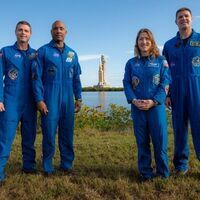



Artemis II will carry four astronauts three Americans and one Canadian around the Moon, in what will be the first crewed mission of the programme.
The launch is expected at Cape Canaveral, Florida in theUnited States, drawing attention around the world to a mission seen as a key step in returning humans to the Moon.
According to local Florida newspapers, some 400,000 people are expected to turn up to watch the liftoff, which is currently slated for Wednesday at 6:24 pm local time (22h24 UT)
More than six decades ago, the US was making a very different case for the future of space.
Artemis II: humanity's return to the Moon reaches the launch pad
A call for cooperation
On 20 September, 1963, President Kennedy stood before the United Nations General Assembly inNew Yorkand delivered a message aimed firmly atSoviet leaderNikita Khrushchev, even if his name wasn't heard.
Kennedy warned against the increase of military power on both sides of the Cold War divide by both the US and the Soviet Union.
Too long, we have increased our military budgets, our nuclear arsenals and our capacity to destroy all life on this hemisphere, Kennedy said.
Calling for disarmament, he welcomed a Soviet proposal to keep weapons of mass destruction out of space.
Why should mans first flight to the Moon be a matter of national competition? he asked.
Kennedy proposed a joint mission and said scientists and astronauts from different countries could work together, sending not the representatives of a single nation, but the representatives of all of our countries.
No joint landing
Khrushchev left power in 1964. His son later said the Soviet leader had rejected an earlier offer so as not to reveal the Soviet Unions technological lag, but might have accepted the second one. Instead, the two powers went their separate ways.
Less than six years after Kennedys assassination, the US landed on the Moon alone in 1969. Twelve Americans walked on its surface between 1969 and 1972.
At the same time, countries around the globe began setting rules for space. The 1967Outer Space Treatylaid out principles for exploring and using space, including the Moon and other celestial bodies.
Further agreements followed in 1968, rules were set for rescue operations and in 1972, responsibility in case of problems involving artificial satellites was clarified.
This cooperation continued after the fall of the Berlin Wall, first with regard to theMir space stationand later on the International Space Station.
But geopolitical tensions did not disappear with the lifting of the Iron Curtain.
"Fast-forward to today, and the current sharp escalation of security threats in and from outer space requires a legally binding agreement to preserve its peaceful nature," writes the UNon its website.
"However, the most recent attempts in theGeneral Assemblyand theSecurity Councilto adopt a document on aweapons-free outer space have failed."
Power play: why NASA is betting on nuclear to outpace rivals on the Moon
Back to the Moon
In 2017, US President Donald Trump announced plans to revive a programme similar to George W Bushs cancelledConstellation programme, which would have carried astronauts to the ISS, as the successor to the US space shuttle programme, which was shuttered in 2011.
Trump's stated aim was toreturn to the Moon and stay there if possible beforeChina. To this end, theArtemisMoon exploration programme was established in 2017, with Artemis II set to be the first mission to carry astronauts.
The Canadian Space Agency is taking part, along with theEuropean Space Agency(ESA) and Japans Jaxa, as is theUnited Arab Emiratesthrough the Mohammed bin Rashid Space Centre. Italy has a separate bilateral agreement linked to the supply of a module for the lunar surface. French companies involved include Airbus, Latelec and ArianeGroup.
NASAsSpace Launch Systemis the most powerful rocket in history among those certified for crewed flights,but the mission carries risks.
Shortly before the launch ofArtemis Iin 2021, a liquid hydrogen leak during fuelling forced three members of a red team to go on to the launch pad and tighten bolts, in front of hundreds of tonnes of highly explosive liquids.
Russia's first lunar mission in 47 years smashes into the moon in failure
Building a lunar future
Artemis aims to build an overall system on the Moon and test what can be done there making bricks, producing fuel, installing solar panels, and even a civilian nuclear power plant.
Europe has built theEuropean Service Module, a crucial part of theOrion spacecraftthat will carry the first crews around the Moon from Artemis II onwards. Four have been delivered, potentially enough for missions up to Artemis IV.
The astronauts are already training for their mission. In 2024 in Cologne, the ESA opened Luna, alunar simulation siterun jointly with the German Aerospace Centre (DLR), where crews can learn to move across artificial Moon dust.
Private companies too are now central to the programme especially when it comes to landing systems, in which Blue Origin, the space company founded by Jeff Bezos, and SpaceX, led by Elon Musk, are both involved. While NASA will send the next humans on their journey to the Moon, private firms are expected to be the ones putting them on its surface.
Blue Origin has paused its space tourism flights to focus on its larger New Glenn rocket and its work on the Moon. Its first cargo lander,Blue Moon MK-1, arrived at NASAs Johnson Space Centre in Houston in early February.
SpaceX, meanwhile, hopes to step up tests of its Starship system. In February,Musksaid his company was now refocusing on the Moon, with the goal of building a first autonomous city.
We can potentially achieve this in less than 10 years, whereas Mars would take more than 20 years, Musk said adding that launches to the red planet come every 26 months, while we can do a launch to the Moon every 10 days.
From the Lab: Why Lanzarote is drawing astronauts to the Canaries
Risks and rivalries
The Artemis programme should not be confused with theArtemis Accords, which date from 2020. Backed byWashingtonbefore the end of Trumps first term, they created a legal framework around the exploitation of space resources and have now been signed by around 60 countries.
However, Russia was excluded from early talks, while China was not part of the process either.Russiais now working with China on its own lunar plans under theILRS projectand sees the Artemis Accords as centred on US interests.
Francedid not sign the accords until 2022, after checking they would not conflict with existing treaties, given the 1967charter states that no state or private company can appropriate anything in space. By creating safety zones to protect activities on the ground, the accords raise the question of whether this amounts to taking control of territory on the Moon.
And by allowing private companies to exploit space resources, the Artemis Accords also raise the question of who gets to take possession of those resources.
These questions will be discussed among those who can be part of the adventure and who will be able to go there. Artemis creates this framework, said Lionel Suchet, deputy director general of the French National Centre for Space Studies.
Europe's quick-fit spacesuit to be tested aboard ISS by France's Adenot
The accords are also unusual in the way they were drafted and adopted.
It is the first time we have had this kind of international act, legal expert Lucien Rapp, scientific director of theSirius Chairresearch programme, told RFI.
A text proposed unilaterally by a space power is being signed by other states, but not all together, one by one,Rapp said.
Trump plans to send humans to the Moon in 2028 if possible, setting out plans to assert American leadership in space, lay the foundations for a lunar economy, prepare for missions to Mars and inspire a new generation of explorers in a 2025 executive order.
Different countries may soon be operating side by side near the Moons south pole Americans, Russians, Chinese, Indians and others, each with their own bases and projects raising the practical question of how those missions will coexist, and whether cooperation will be possible on the ground.
The 1967 Outer Space Treaty says space should be used for the benefit and in the interests of all countries. But as new missions take shape, that principle will be tested.
This story was adapted from theoriginal versionin French byIgor Gauquelin
Originally published on RFI