


Every year on 16 September, the UN celebrates the international communitys success inhealing the ozone layerand brings attention to what more can be done to protect the planet.
UN Secretary-General Antnio Guterres has urged world leaders to get serious and deliver as they begin arriving in New York for the high-level week of the 80th General Assembly.
As billions continue to breathe polluted air that causes more than 4.5 million premature deaths every year, UN climate experts on Friday highlighted how damaging microscopic smoke particles from wildfires play their part, travelling halfway across the world.
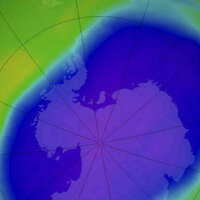
Last century, scientists confirmed the alarming reality of a significant depletion in the ozone layer an invisible shield of gas which surrounds the earth and protects it from the suns UV rays.
The collection of ozone-depleting substances included CFCs, or chlorofluorocarbons, which in the mid-1980s were commonly found in everyday products such as air conditioners, fridges and aerosol cans.
Science led to global action. Realising that harmful UV radiation was entering the atmosphere through what was potentially a damaged ozone layer, countries made a commitment under the Vienna Convention in 1985, to do what was needed for the protection of the people and the planet.
The Vienna Convention and its Montreal Protocol became a landmark of multilateral success, said the UN Secretary General Antnio Guterres in a message for this years World Ozone Day.
Today, the ozone layer is healing, he said.
What is the Vienna Convention?
Forty years ago, countries came together to take the first step in protecting the ozone layer, guided by science, united in action, the UN chief continued.
TheVienna Conventionfor the Protection of the Ozone Layer, adopted and signed by 28 countries on 22 March 1985, formalised universal cooperation over the protection of the fragile ozone layer.
It is the first treaty to be signed by every country in the world and the precursor to theMontreal Protocol.
The objective of the Montreal Protocol is to monitor the global production and consumption of substances that deplete the ozone layer and eventually eliminate them.
Multilateralism at its best
In avideo message, Inger Andersen, Executive Director of the UN Environment Programme (UNEP), highlighted that through action under the conventions ozone depleting substances have now been virtually eradicated and the hole in ozone layer is closing.
After scientists sounded the alarm, countries, nations, and businesses came together and took action for the planet.
That ismultilateralism at its very, very best, she added.
The Montreal Protocol has been progressing well in both developed and developing countries with most phase-out schedulesthe time given for each country to gradually stop the production of harmful substancesadhered to or even surpassed.
This achievement reminds us that when nations heed the warnings of science, progress is possible, remarked Mr. Guterres.
Next in line, the Kigali Amendment
In his message, Mr. Guterres urged governments to ratify and implement the Kigali Amendment to the Montreal Protocol, which commits to phase down, or reduce, hydrofluorocarbons (HFCs), greenhouse gases used mainly in cooling technologies.
Implementing the Kigali Amendment could avoid up to 0.5 degrees Celsius of warming by the end of the century, he said. Paired with energy-efficient cooling, we could double these gains.
As outlined in theParis Agreement, countries have agreed to try and limit the rise of global temperature to 1.5 degrees Celsius.
On this World Ozone Day, lets recommit to preserving our ozone layer and to protecting people and planet for generations to come, the UN chief said.